

By Maheen Mustafa / Sapan News
Amidst grim politics, on a rainy and grey day in Seattle, here was a room full of brilliant minds, a dynamic South Asian and diaspora community of filmmakers and their supporters who dared to dream and tenaciously make their dreams come true by creating impactful films.
Founded by Rita Meher and Farah Nousheen, Tasveer Film Festival has played a pivotal role in providing a global platform for South Asian films. This year, the festival launched North America’s first global film market dedicated to South Asian filmmakers. It is also the only Oscar-qualifying South Asian film festival worldwide for the short film genre.
Being at Tasveer felt like being part of a parallel world – a euphoric, colourful world. Vibrant outfits, beautiful faces, happy people embracing each other’s wins, and taking pride in their creative work.
Tasveer has created a safe space for South Asian creatives to come together, particularly those from India and Pakistan who could not meet, mingle, or work together in their own countries. These meetings led to camaraderie and collaboration. Through this platform, for example, the film Wakhri (‘one of a kind’), inspired by the life of slain Pakistani social-media star Qandeel Baloch, now has Deepa Mehta on board as a producer.
“As actors, we pour so much of ourselves into each role, and seeing that work come to life in front of an engaged audience was incredible” exclaimed actor Priyanka Zemse after watching the feature Me, Raani that she stars in. The film won the 2024 Best of India Short Film Festival in Mumbai.
Her performance as Anju, a single mother working as a maid with a relentless commitment to educating her daughter, Raani, is vulnerable and raw. Anju dreams of the marble-playing Raani becoming an engineer in a patriarchal society where the future of girls is all-too-often a child marriage.

The Tasveer Film Festival is designed to reshape financial and distribution models for South Asian filmmakers globally by hosting events, industry panels, and networking sessions. With a rich legacy spanning two decades, Tasveer proactively promotes diversity, inclusion, and representation in art.
Winners of best feature film were Wakhri, screened at the opening night, along with the thought-provoking and innovative animated Marathi short Loop Line; best narrative feature A Nice Indian Boy; and best social justice film was A Lullaby for Yellow Roses. The complete list of this year’s winners is here.
At the post-screening discussion of A Nice Indian Boy, a groundbreaking Hollywood-meets-Bollywood rom-com starring a cross-cultural same-sex couple, director Roshan Sethi – who also happens to be a physician affiliated with Harvard University – shared how difficult it was to finance the film. It was only when Jonathan Groff, the Caucasian lead actor accepted the role opposite Indian origin Karan Soni – Sethi’s real-life spouse – that investors began taking the production seriously.
There were so many winning entries, even if they didn’t win an award. Particularly moving is Paper Flowers based on the true story of Shalin, an Indian-origin student who graduates from the University of Southern California, committed to his Taiwanese-origin girlfriend, Fiona (Frances) Chang – a cross-racial relationship the film delicately depicts.
Shalin is diagnosed with cancer shortly after joining the US Peace Corps in Peru. We already know the tragic outcome so it’s poignant to see the lead character celebrate life, cherish every moment and every sunset.
The portrayal of their parents’ hesitations about the couple’s cross-cultural relationship initially faced some pushback, revealed the film’s producer Asit Vyas. However, they came around to it and are happy with how it was made.
Another outstanding film is Kamran Anwar’s documentary Songs of the Sufi which covers the history, culture, etiquette, and roots of Qawwal. His interest stems from the roots of his family’s history as supporters of Qawwal families in Hyderabad, India for seven generations.
Anwar’s film traces the roots of Qawwali, how it evolved, and what it symbolises. He also wanted to inspire the next generation to be curious about the genre and respect it.
Abid Aziz Merchant, one of the producers of Wakhri, inspired by the life of Pakistani social media star Qandeel Baloch, is focusing on distribution. The team is delighted to have the well-known filmmaker Deepa Mehta on board as executive producer. With her name on the credits, they hope to “get a streaming platform where the world can watch it”, Merchant told Sapan News.
The film, yet to be released in Pakistan, has been screened in 17 festivals, including Tasveer. It is also being premiered in India and Barcelona.
One of its highlights is the stirring music by well-known names like composer Abdullah Siddiqi and singers Ali Sethi, Resham Faiz Bhutta, and Meesha Shafi. The soundtrack is available on Spotify.
Tasveer also platformed bold directorial debuts like the short Not a Fiction (4.5 min) by Shah Newaz Khan Cju, an independent filmmaker in Dhaka, Bangladesh. In less than five minutes, the director relays a powerful message about extrajudicial killings in Bangladesh from the perspective of a silent onlooker, an old tree. The single-shot film took him three years to make.
Bangladesh’s Rapid Action Battalion and other law enforcement agencies are responsible for more than 600 extrajudicial killings since 2018, according to Human Rights Watch. Dedicated to victims all over the world, Not a Fiction depicts one such incident, a composite of many stories.
The power of storytelling shone through at the Tasveer Film Festival, a key player and pivotal stakeholder in the global South Asian film market. Since its inception in 2002, the festival has consistently amplified South Asian narratives and boosted their visibility on the world stage.
Maheen Mustafa is a journalist, global strategist and founder of MTG, a Seattle-based media outlet and production house that aims to elevate and amplify BIPOC and immigrant narratives and perspectives. She focuses on social impact, wellness, business, culture, climate, race and global news. Follow her on Twitter.
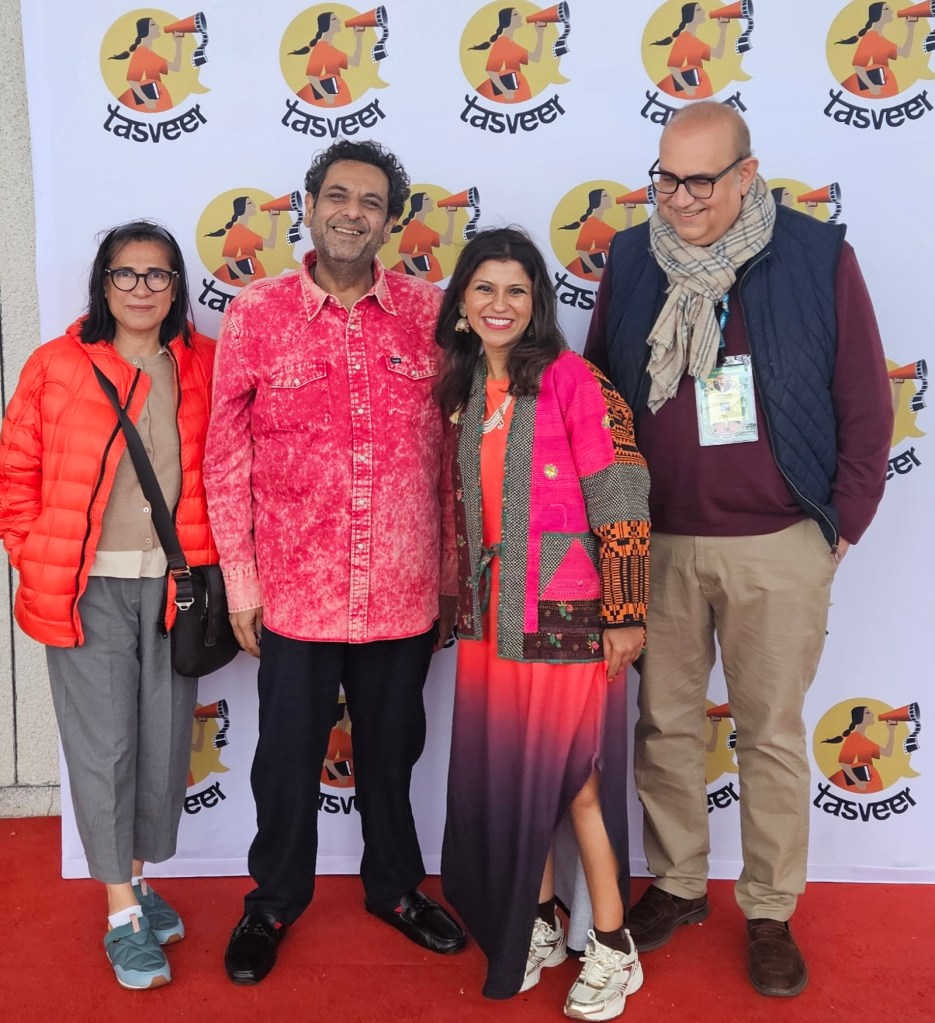
Lead image: Hemal Trivedi, Mumbai-based director of the documentary Yatra, with actor Zen at Tasveer Film Festival 2024 (Photo: Beena Sarwar)

 South Asia Union
Leave a comment