By Beena Sarwar / Sapan News
The idea of a ‘Young South Asian Artists’ exhibition struck a chord when acclaimed Lahore-based artist and educator Salima Hashmi mentioned it some years ago, after writer and curator Manmeet K. Walia from New Delhi approached her about it.
Salima Hashmi, known for her creativity and longstanding commitment to peace, democracy and human rights, is also a founder member and advisor for the Southasia Peace Action Network which nearly 90 of us launched online in March 2021.
Her lifetime of hard work, struggle, and consistency stand apart from the legacy she inherited from her illustrious father, the celebrated poet Faiz Ahmed Faiz.
When Prof. Hashmi and Ms. Walia presented their then under-production show at the Faiz Festival in Lahore, 2023, what stood out was the creativity and courage they were showcasing.
Two years later, their intergenerational, cross-border collaboration came together in the major exhibition titled ‘(Un)Layering the future past of South Asia: Young artists’ voices‘. The show launched at the School of Oriental and African Studies Gallery, London, in April, is supported by The Ravi Jain Memorial Foundation and the Dhoomimal Gallery, New Delhi.
Featuring the works of 26 young artists from Afghanistan, Bangladesh, India, Nepal, Pakistan, and Sri Lanka, the multidisciplinary exhibition takes South Asia’s stories to a global stage.
A special half-day event in London last Tuesday, 10 June, titled ‘South Asia: people, promise and potential – art, film and discussion’ at the Bloomsbury Institute London brought together the South Asian artists exhibit with a documentary I had made in Sri Lanka last year.
The event started with a meetup hosted by Arif Zaman, who teaches business and leads enterprise outreach at the Bloomsbury Institute in the Knowledge Quarter, London. The Bloomsbury Institute was the world’s first independent provider to join the UN Sustainable Development Goals network for higher education institutions.

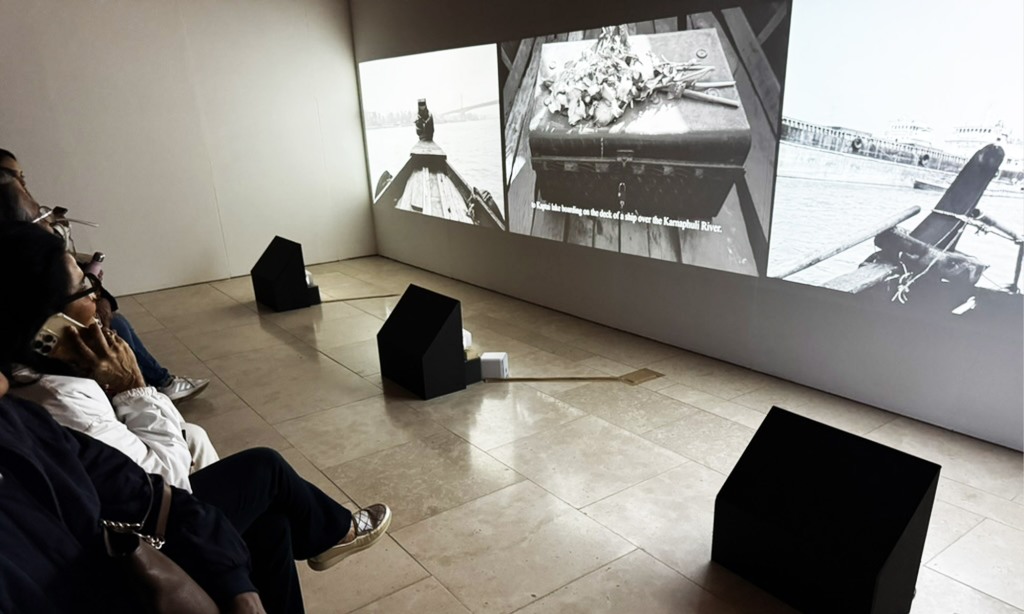
Manmeet Walia led a walkthrough of the exhibit. Showcased across three floors, it incorporates haunting elements that emerge from deep pain, introspection, and clearly, masses of research. The artists address various urgent themes and struggles across the region through various media. Their home countries are deliberately kept out of the descriptions because as Ms. Walia said, “We don’t want to box them into national identities”.
One poignant piece is Fragile Balance, a prayer rug made of lit and unlit matchsticks, by Hadi Tahnaward, 2023.
The video of a woman in a blue burqa, seated by a mud wall, singing softly in the traditionally celebratory Baloch genre known as Leeko, plays on a loop under the stairs. Her keening runs through the gallery, conveying her pain as she mourns the loss of family members. Aiman Amin, the youngest artist in the show who graduated from Beaconhouse National University in Lahore last year, came across the woman while visiting Balochistan and sat recording her for hours.
The Longest Revolution is an incredible piece of embroidery in running stitch. It took the artist Varunika Saraf a year to make and bring together various movements for women’s rights in India.
Another textiles-based piece is the sprawling collaborative installation Hum Bhi Dekhenge (We Too Will See), by Pakistani and Indian artists Purvai Rai and Maheen Kaazim. Having never met, they worked together on Zoom to put the piece together. It exemplifies ‘CreaTech’, bringing together the creative and technology fields.
These are just some of the pieces in the show, each worth savouring and sitting with, curated well before the latest India-Pakistan conflict put up more walls between our two countries.
One hopes that more galleries will host this incredible resource with its deep insights, promoting curiosity, empathy and understanding across borders.
Beena Sarwar is a journalist and peace activist from Pakistan based in the Boston area. She is the founder editor of Sapan News and co-founder and curator of the Southasia Peace Action Network. This is part of her occasional Personal Political column.


 South Asia Union
Leave a comment